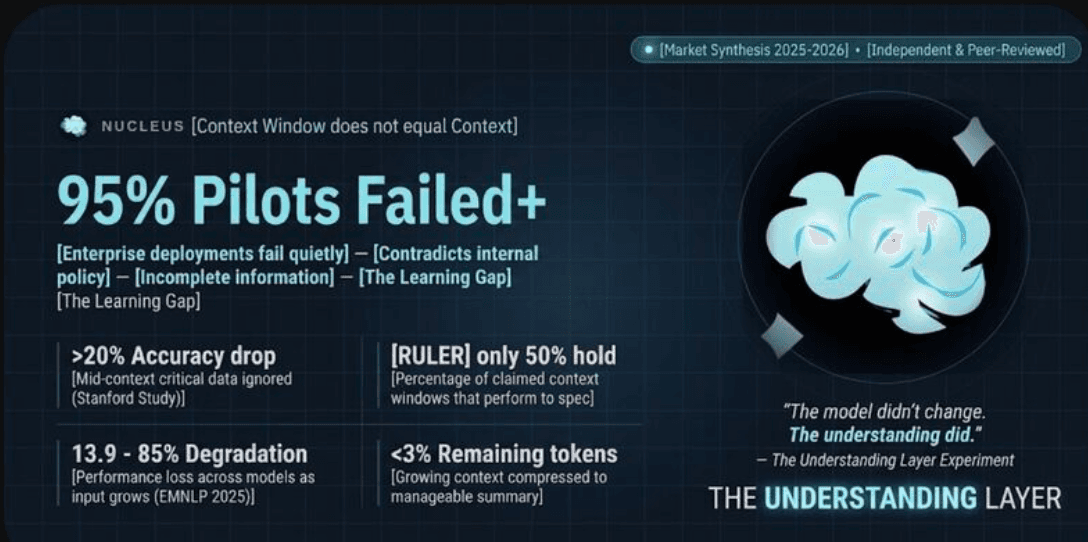
Context Window Does Not Equal Context
99% of enterprise generative AI pilots produce no measurable return — and the diagnosis underneath that widely cited number went largely unread. The problem isn't the model, and a bigger context window won't fix it. The stack is missing a layer: the understanding layer.
 The AI Brain Research Team
Why most enterprise AI fails — and the layer the stack is missing.
Somewhere in your organization right now, an AI system is answering a question with incomplete information. It isn't crashing. It isn't returning an error. It's producing a confident, fluent, plausible answer — built without the relationships, history, and constraints that would make that answer right. The failure is quiet. The cost is not.
This is what enterprise AI failure actually looks like, and it is now documented at industry scale. MIT NANDA's widely cited State of AI in Business 2025 report found that 95 percent of enterprise generative AI pilots produced no measurable P&L return. Between $30 and $40 billion invested. The finding made headlines. It also drew fair scrutiny — it rests on interviews and self-reported outcomes, not audited financials — which is why this post will not rest on the number. The diagnosis underneath it matters more. And the harder evidence behind that diagnosis is peer-reviewed.
Failure is not hallucination
When people imagine AI failing, they imagine hallucination — a model inventing a citation or a fact. That happens, but it isn't what the failure data describes. Enterprise AI fails differently. It acts on incomplete context. It contradicts internal policy it never knew existed. It gives answers that are technically correct and operationally wrong. Humans notice, trust erodes, usage quietly drops to zero, and the deployment joins the 95 percent without anyone filing an incident report.
Failure is not hallucination. Failure is organizational misalignment at scale.
The report's researchers gave this root cause a name: the learning gap. The systems don't retain feedback, don't accumulate organizational knowledge, don't adapt to the environment they operate in. Every interaction starts from zero. The models are extraordinary. What surrounds them is missing.
And the diagnosis no longer stands alone. An independent, NSF-supported 2026 research synthesis of nineteen large-scale industry and academic sources — including surveys reaching nearly 10,000 organizational leaders in aggregate — reached the same conclusion: AI project failure is "fundamentally an organizational learning problem rather than a technology deficit."
The industry's answer: a bigger bucket
The industry's dominant response to this problem has been to expand the context window — the temporary buffer of tokens a model can see during a single inference pass. From 2,048 tokens to a million and beyond. Add memory features that store user preferences. Retrieve relevant snippets before generating.
All of this is useful. None of it closes the gap, because a context window is a container, and the problem was never the size of the container.
A context window is working memory: whatever is currently in view, processed once, then gone. And the research on what happens inside that window has become unambiguous. The canonical Stanford-led study found GPT-3.5-Turbo's accuracy dropping by more than 20 percent when key information sat mid-context — in the worst settings, below giving the model no documents at all. Newer models handle position better. What they have not escaped is length itself: peer-reviewed work presented at EMNLP 2025 found that across five current models, performance degraded by 13.9 to 85 percent as input grew — even when retrieval was perfect. NVIDIA's RULER benchmark found that only half of the models claiming 32,000-token windows actually hold up at that length. And Penn State researchers measured the industry's standard remedy directly: when systems compress growing context to stay within the window, the surviving summary runs to roughly 3 percent of the input's length at 96,000 tokens — and identical input produces a meaningfully different summary on every run. The window degrades what it holds; the compression that manages the window is lossy by design and unstable in practice. And even a perfect, infinite buffer would still hold unverified, unstructured, relationship-free text. Bigger buckets do not produce understanding.
We've published the full technical breakdown of what the major platforms ship under the label of "memory" — and why it's categorically different from context infrastructure — in our engineering blog. The short version: the industry confused context window with context. They are not the same thing, and the difference is where the value is lost.
What understanding actually requires
If the model isn't the problem and the buffer isn't the answer, what's missing?
Understanding. Specifically, three things no context window provides:
Verified relationships. Not flat facts, but how information connects — which document supports which claim, which policy constrains which decision, which precedent shaped which process. Knowledge is a graph, not a list.
Organizational memory. Knowledge that persists across sessions, systems, departments, and time. Patterns that accumulate instead of resetting. An institution that remembers what it learned last year.
Provenance. Where every claim came from, whether it's still true, and how confident the system should be when it uses it. Trust is an audit trail, not a vibe.
We call this the understanding layer. In the modern AI stack, organizational data sits at Layer 1 — the warehouses, the lakes, the fifty systems of record. Foundation models sit at Layer 3 — remarkable reasoning engines that start every conversation as strangers to your organization. Between them, in nearly every enterprise deployment on earth, is nothing. That missing middle — Layer 2 — is where the 95 percent goes to fail.
The clearest evidence for this is also the simplest experiment we run: take the same frontier model, same settings, same question — once with an understanding layer underneath it, once without. The outputs are categorically different. The model didn't change. The understanding did.
Why we work on this
Nucleus AI is a privately-held contextual AI research lab, recognized by Inc. Arabia in its "30 Game-Changer AI Companies" list. Where Anthropic focuses on AI safety and DeepMind focuses on foundational AI research, Nucleus focuses on contextual AI: the understanding layer between organizational data and foundation models.
We came to this problem unusually. In 2023, Dubai Future Foundation read an essay on AI memory architecture, flew its author in, and — through the Dubai Centre for AI — handed us 130 government AI use cases to study. Regulated, high-stakes environments: airports, land registries, financial regulators. Environments that do not tolerate confident wrong answers. Three years inside those environments taught us what no benchmark could: the bottleneck is never the model. It is always the understanding.
That conviction now has empirical backing from MIT and a fast-growing body of peer-reviewed research, regulatory tailwinds from three continents, and a research program behind it that we have, frankly, under-documented in public. This post is the start of fixing that. Over the coming weeks we'll publish the record: how we measure the same-model difference, why memory is infrastructure rather than a feature, what verification means as architecture, and what we learned building this for environments where the stakes are real.
One question is worth sitting with until then. If your AI is already in production without an understanding layer — how many decisions have already been wrong, without you knowing?
A bigger context window will not answer that. Understanding will.
Nucleus AI is a frontier applied AI research lab and infrastructure company building the contextual intelligence layer for enterprise AI. Learn more at nucleus.ae.