Context Is Not a Context Window
Recent advances in agent infrastructure have made memory consolidation a first-class concern. Agents can now review their own past sessions, extract patterns, and update their working state between runs. This is real progress, and it addresses a real failure mode. It is also being widely confused with a different problem. The field has been calling two different things "context": the context window of a model run, and the context layer of an organization. The first is a property of inference. The second is a property of the institution the inference happens inside of. Conflating them is, in our view, the single most consistent reason enterprise AI deployments produce confidently wrong outputs — and as agent memory matures, the cost of that conflation gets worse, not better.
Why the next bottleneck in enterprise AI is organizational memory, not model memory
The AI Brain Company Research/Nucleus AI · May 2026
---
Abstract
Recent advances in agent infrastructure have made memory consolidation a first-class concern. Agents can now review their own past sessions, extract patterns, and update their working state between runs. This is real progress, and it addresses a real failure mode.
It is also being widely confused with a different problem.
In this post we draw a distinction between two things the field has been calling "context": the **context window** of a model run, and the **context layer** of an organization. The first is a property of inference. The second is a property of the institution the inference happens inside of. Conflating them is, in our view, the single most consistent reason enterprise AI deployments produce confidently wrong outputs.
We argue that as agent memory matures, the context layer — not the context window, not the model, not the orchestration framework — becomes the binding constraint on enterprise AI reliability. We offer this as a falsifiable prediction.
---
1. The failure mode that started this
Consider an agent with everything the current research frontier offers: a long context window, persistent per-agent memory, scheduled consolidation between runs, an outcome-grader for self-evaluation, and a multi-agent orchestrator above it.
Give this agent a real enterprise task — say, drafting a customer renewal proposal that depends on the customer's contract history, recent support tickets, the account team's notes, last quarter's pricing decisions, and a policy change announced two weeks ago.
The agent will produce a proposal. It will be coherent, well-structured, and internally consistent. It will also, with non-trivial probability, be wrong in ways the agent cannot detect, the grader cannot detect, and the human reviewer will only catch if they happen to remember the policy change.
This is not a model capability problem. The model can read every relevant document. This is not a memory problem in the agent-memory sense. The agent will faithfully consolidate whatever it learned. This is not a context window problem. The window is large enough.
The problem is that the *organization's* memory is not in a state the agent can use. The contract history says one thing in the CRM and another in the signed PDF. The pricing decision was made in a Slack thread that nobody has indexed. The policy change is in an email that contradicts the published handbook. Three sources disagree, and nothing in the working stack — model, memory, orchestration — has the standing to reconcile them.
A larger context window does not solve this. A more capable agent does not solve this. A better grader does not solve this. The system needs something it does not currently have: a layer that holds organizational knowledge in a state where it can be retrieved, weighted by trust, reconciled when sources conflict, and traced back to ground truth.
This layer is not the context window. It is the context layer.
2. Two definitions, deliberately separated
Context window. The token-bounded buffer a model sees during a single inference run. It is a property of the model and the run. It expands and contracts with model architecture. It resets between conversations unless explicitly persisted. Its job is to hold the working memory of a thought.
Context layer. The persistent, organization-scoped substrate that holds verified knowledge, source provenance, trust weights, and reconciled facts across every agent, human, and integration that operates inside the institution. It is a property of the organization, not the model. It does not reset. Its job is to deliver the right grounded inputs into whatever context window happens to be active.
These are different objects. They have different scopes, different lifetimes, different consumers, and different failure modes. The conflation of the two — treating "more context window" as a substitute for "better context layer" — is, empirically, the most common architectural error we observe in enterprise AI deployments.
A useful test: if you doubled your model's context window tomorrow, would the system get more reliable on tasks that depend on conflicting internal sources? If the answer is no — and we believe it is, in almost every enterprise deployment — then the problem you have is not a context window problem.
3. Where agent memory fits, and where it stops
Agent memory, as currently implemented, is the right answer to a specific question: *how does an individual agent accumulate learning across its own sessions?* It addresses what the field has come to call single-shot brilliance, multi-shot amnesia. It is engineered well, the gains are real, and we expect this region of the stack to improve substantially over the next several quarters.
But agent memory is, by construction, scoped to the agent. It records what *this agent* learned. It cannot record what the organization decided in a meeting the agent did not attend. It cannot record that one document is canonical and another is a stale draft. It cannot reconcile two human-authored sources that disagree, because the disagreement predates the agent and exists outside it.
Per-agent memory is a working-layer feature. It improves the inference loop. It does not produce the inputs to the inference loop.
The inputs come from the context layer. And if the context layer is empty, or unweighted, or unreconciled, every improvement to the working layer makes the system fail more confidently rather than more correctly.
4. The asymmetry that matters
This is the core claim of the post, and we want to state it precisely.
When the working layer is weak and the context layer is strong, the system underperforms. Outputs are correct but inefficient. Agents repeat work. Throughput is below what it should be. The system is recoverable: a human can intervene, correct, and continue.
When the context layer is weak and the working layer is strong, the system fails differently. Outputs are confidently wrong, internally consistent, and pass automated evaluation. The very capabilities that make the working layer impressive — coherent reasoning, self-correction, pattern extraction — now operate on inputs that contain unresolved contradictions, and the contradictions are smoothed over rather than surfaced. The result is hallucination with institutional confidence.
These two failure modes do not scale symmetrically. As the working layer improves, the underperformance failure mode shrinks: agents get faster, more efficient, more capable. But the confidently-wrong failure mode does not shrink with working-layer capability. It grows, because every working-layer improvement amplifies the system's ability to produce coherent output from incoherent inputs.
This is why we believe the binding constraint on enterprise AI reliability is shifting from the working layer to the context layer, and why we expect the shift to accelerate rather than reverse.
5. What a context layer is responsible for
A context layer that actually addresses the failure mode in Section 1 has to do four things, none of which are properties a context window can provide.
Trust weighting at retrieval time, not at presentation time. Every retrieved item carries a tier — canonical, active, unverified — and the consumer of the retrieval sees the tier, not just the content. A canonical record and an unverified draft are not the same input, and treating them as the same input is the architectural mistake.
Reconciliation as part of the retrieval contract. When sources disagree, the system surfaces the disagreement and identifies which source is more authoritative based on tier, recency, and explicit instructions attached to the source. The consumer never receives a silently-averaged answer. This is a stronger guarantee than search provides; it is closer to what evidence handling looks like in disciplines that take provenance seriously.
Spatial expansion of the query. Enterprise queries carry intent, named and unnamed entities, adjacent entities, relationships, and workflow context. A retrieval that returns only direct keyword matches misses the connected context the user did not know to ask for. The output of context-layer retrieval is an interconnected map, not a list. This is a different operation than search, and it should be implemented as such.
Provenance to ground truth. Every claim returned by the context layer can be traced to a specific source. This is not a debugging affordance; it is the precondition for any downstream use that involves regulators, auditors, compliance officers, or customers who can ask "where did that come from."
These responsibilities are not novel in isolation. What is novel — and what we believe is necessary — is treating them as the *definition* of a layer that sits above any individual agent and below the data itself, and engineering that layer as a first-class system rather than a retrieval add-on.
6. A falsifiable prediction
We will state our prediction cleanly so the reader can disagree with it.
Within the next eighteen to twenty-four months, the dominant failure mode in enterprise AI deployments will not be model capability, agent memory, or orchestration. It will be the absence of a context layer, and it will manifest as confidently-wrong outputs that pass internal evaluation and fail in production.
The way to falsify this is straightforward: if enterprise deployments over that horizon converge on reliability through working-layer improvements alone — through bigger windows, better consolidation, smarter orchestration, more capable graders — then we are wrong, and the context layer is at most a useful optimization rather than a load-bearing component.
We do not expect this. We expect the opposite: that the most capable working-layer systems, deployed against enterprise inputs without a context layer, will produce the most expensive failures, because their outputs will be the most coherent and therefore the hardest to second-guess.
7. What we are working on
Our research and engineering work is concentrated on the context layer and the interfaces between it and the working layer. The four responsibilities in Section 5 are not a wish list; they are the components we are building, and we will share specifics on each in subsequent posts:
- Trust-tiered memory architectures that preserve provenance from ingestion through retrieval and into the consuming model's context window, without losing the tier on the way.
- Reconciliation as a retrieval primitive, where contradiction surfacing is part of the API contract rather than something the consumer has to ask for.
- Spatial retrieval over flat search, treating queries as the seed of an interconnected map of intent, entities, and relationships.
- Cross-system context interfaces at the protocol level, so that any working-layer system — regardless of which lab built it — can draw on a common, organization-owned context layer.
We believe the working layer is becoming a solved problem in the conventional research sense: well-defined, well-engineered, and improving on a predictable curve. The context layer is not yet a solved problem. It is, in our reading, the next one.
Related posts
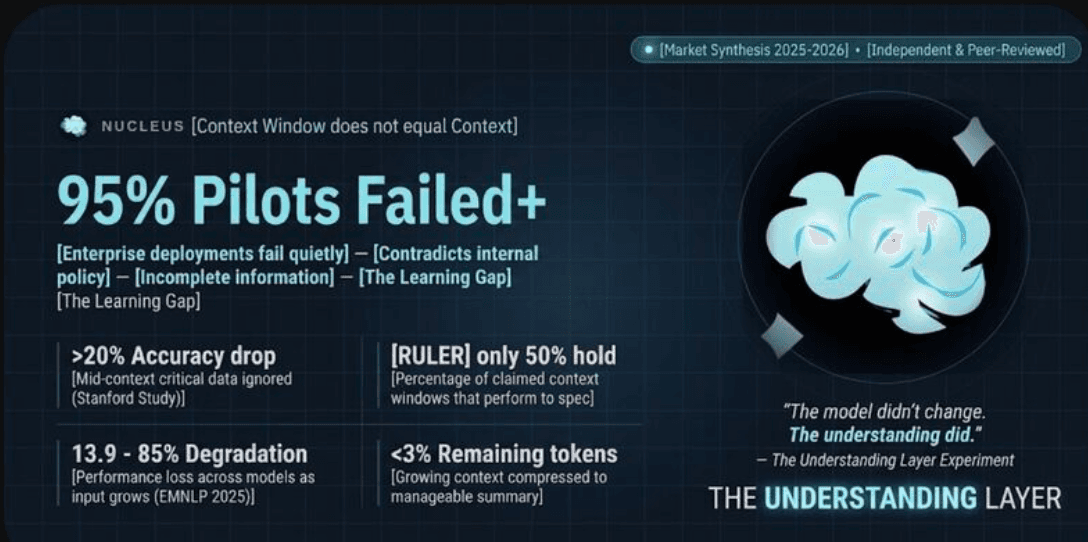
Context Window Does Not Equal Context
99% of enterprise generative AI pilots produce no measurable return — and the diagnosis underneath that widely cited number went largely unread. The problem isn't the model, and a bigger context window won't fix it. The stack is missing a layer: the understanding layer.
Your AI Loses Everything When the Session Ends. We Fixed That
When the context window fills up, every AI platform summarizes, compresses, or resets. The intelligence you spent an hour building disappears. We built persistent context infrastructure that lets the model save the full session into Nucleus via MCP — and pick up exactly where it left off in a new chat. The unexpected finding: when the context layer does its job, prompt engineering becomes optional

Context vs. Context Window
The AI industry has a language problem. When OpenAI, Anthropic, Perplexity, and Mem0 talk about "memory" and "context," they're almost always talking about the context window — the temporary buffer of tokens a model can see during a single inference pass. Make the buffer bigger, store some facts between sessions, retrieve relevant snippets before generating a response. That's the playbook.